Being an “amateur photographer” is a broad label, but it is the one I am using to justify buying a new mirrorless camera. When my wife first suggested it, my immediate reaction was a firm no. I had owned one about ten years ago, and while I used it enthusiastically at first, it eventually ended up tucked away in storage.
This time, though, the idea stayed with me. After some deliberation, I began to feel excited again, especially with two trips on the horizon: an African safari and a `visit to Brazil.
On safari, you are rarely right next to the animals. Zoom is essential. The latest iPhone offers a 5x optical zoom, which is impressive for a phone, but it still felt too limited to capture the kind of close-up wildlife shots we imagined. Since a safari is not something we expect to repeat, it felt worth investing in gear that could do justice to the experience. At worst, if the camera ended up unused afterward, we could sell it and take the financial hit.
The Camera
Once I committed to buying a camera, the harder question was which one to get. I wanted something better than a phone, but not so expensive that it would feel extravagant.
I looked at Canon, Nikon, and Sony, but settled on Canon. I had used one before and liked their lens lineup. Deciding on the model took months.
I first considered the Canon EOS R50, then the R100, but eventually landed on the Canon EOS R7. Two features convinced me: in-body stabilization, which is very helpful when shooting with a long telephoto lens, and dual card slots, which provide instant backups. I skipped full-frame models since they were far more expensive and not something I really needed.
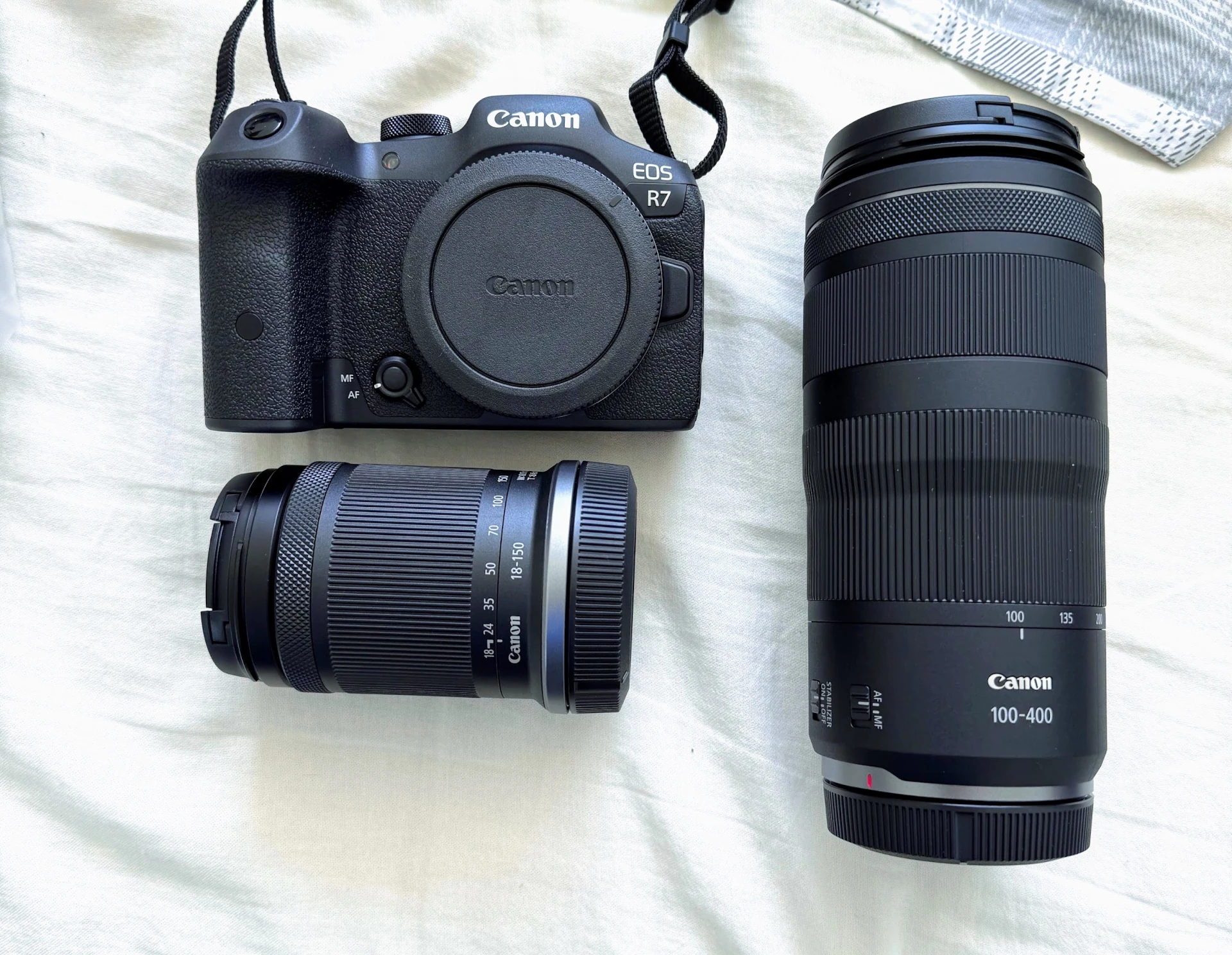
Canon EOS R7 with 18-150mm and 100-400mm lenses
The Lenses
Choosing lenses was just as challenging as choosing the body.
Canon RF-S 18–150mm F3.5–6.3
This choice was straightforward. It is the kit lens, versatile enough for everyday use, and works well in a variety of situations.
Canon RF 100–400mm F5.6–8 IS USM
The telephoto choice took more thought. I wanted reach, but not at the cost of portability or price. A massive lens would have been impractical for travel and hiking. The RF 100–400mm struck the right balance: light enough to carry, with plenty of zoom to capture wildlife.
Canon RF 50mm F1.8 STM
I also picked up a 50mm prime for portraits and low-light shots. It was affordable and adds flexibility for situations where depth of field or light-gathering power matters.
Memory Cards
Fast memory cards were also important, since I planned to use continuous shooting. I chose Lexar 128GB Professional Silver PRO SD cards, which support UHS-II with a minimum V60 write speed.
I bought several smaller cards instead of one large one. Having multiple 128GB cards reduces the risk of losing all photos if a card fails, and it also makes backups easier.
On Safari With the Camera
Now that the safari is behind us, I can say with certainty that buying the camera was the right choice. Some animals came very close, but many did not, and the telephoto lens made it possible to capture detailed, memorable shots. I still remember the first time I zoomed in on a lion resting under a tree. The level of detail was incredible, and that moment alone made the purchase feel worthwhile. I almost used as a binoculars.

Taking photos with the new camera
The parks were dusty, so keeping the camera covered was essential. Changing lenses inside the vehicle worked well, but it required some care to avoid dust getting inside or dropping it on the floor. For most of the trip, the 100–400mm stayed on the camera, while the 18–150mm was useful for landscapes and closer animals. I hardly used the 50mm.
Having multiple memory cards also proved to be the right decision. Shooting in bursts for action moments, like wildebeest crossing a river or lion cubs playing, quickly filled up space. Splitting photos across cards reduced the risk of losing everything in case of failure.
Lessons Learned
Looking back, here are the key takeaways that might help if you are planning to bring a camera on safari:
- A telephoto lens is essential. Most animals will be too far away for a phone or a short zoom. Something in the 100–400mm range is a great balance of reach and portability.
- Stabilization matters. Long drives are bumpy, and even when parked the ground is not perfectly stable. In-body stabilization made a noticeable difference.
- Protect against dust. Dust is everywhere. Keep your gear covered, bring a cleaning kit, and avoid changing lenses when the car is moving.
- Multiple cards are safer. Several smaller memory cards are better than one big one. They reduce the risk of losing all photos and make backups easier.
- Portability counts. Large professional lenses may offer better quality, but they are heavy, expensive, and difficult to manage in a safari vehicle. A mid-range telephoto is more practical.
- Know your gear before you go. Practicing with the camera at home saved time in the field. Learning the menus and settings ahead of time meant I could focus on the animals, not the controls.
Final Thoughts
The Canon R7 and the lenses I chose proved to be the right setup. The telephoto gave us the wildlife photos we had dreamed of, and the mid-range zoom handled everything else. I still do not know if the camera will stay in use or eventually gather dust again, but for now it has already paid for itself in memories.
If you want to see some of the results, I have posted photos on Instagram, and some high-resolution versions are also available on Adobe Stock.